Why Your Laravel API Is Slow: 9 Performance Problems You Should Check First
A practical guide to finding and fixing slow Laravel APIs, from database queries and N+1 problems to external APIs, serialization, caching, queues, and application architecture.
- Laravel
- PHP
- API
- Performance
- Optimization
- MySQL
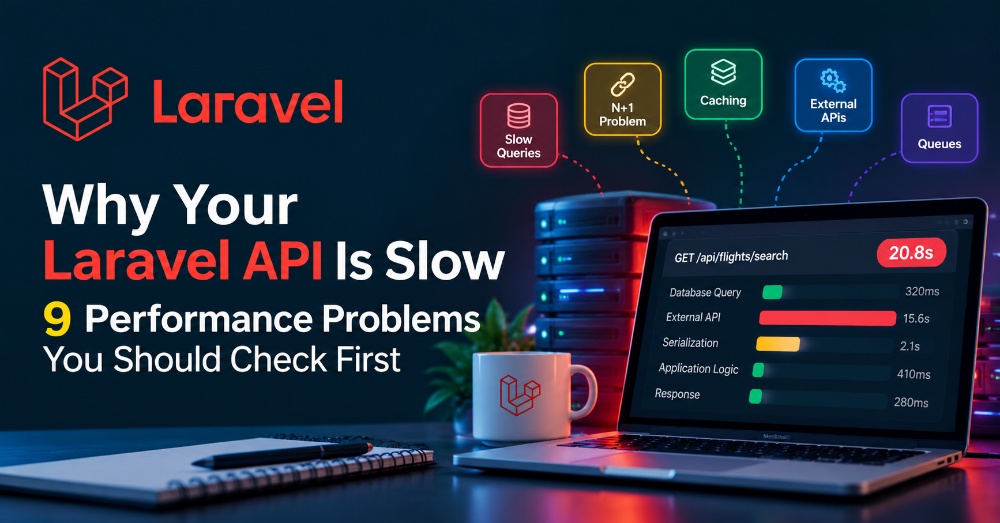
Why Your Laravel API Is Slow: 9 Performance Problems You Should Check First
A Laravel API can feel fast during development and become painfully slow when real traffic, large datasets, and multiple external services enter the picture.
The frustrating part is that the Laravel framework itself is rarely the only problem.
A slow API is usually the result of several small bottlenecks working together:
- Too many database queries
- N+1 queries
- Missing database indexes
- Large datasets being loaded into memory
- Slow external APIs
- Unnecessary serialization
- Missing caching
- Long-running work being handled synchronously
- Poorly designed application architecture
The good news is that most of these problems can be identified and fixed systematically.
This guide walks through the most common Laravel API performance problems and how to approach them.
1. Don't Guess — Measure First
The first mistake developers make when optimizing an API is changing code before knowing what is actually slow.
Before optimizing, measure the request.
You need to answer questions such as:
- How long does the database take?
- How many SQL queries are executed?
- Which query takes the most time?
- How long do external API calls take?
- How much memory does the request consume?
- How much time is spent transforming the response?
- Is the problem happening on every request or only with large datasets?
For example, Laravel provides useful tools for inspecting database queries.
DB::listen(function ($query) {
    logger()->info('SQL Query', [
        'sql' => $query->sql,
        'bindings' => $query->bindings,
        'time' => $query->time,
    ]);
});